
Resources · Templates
Letterhead
template.
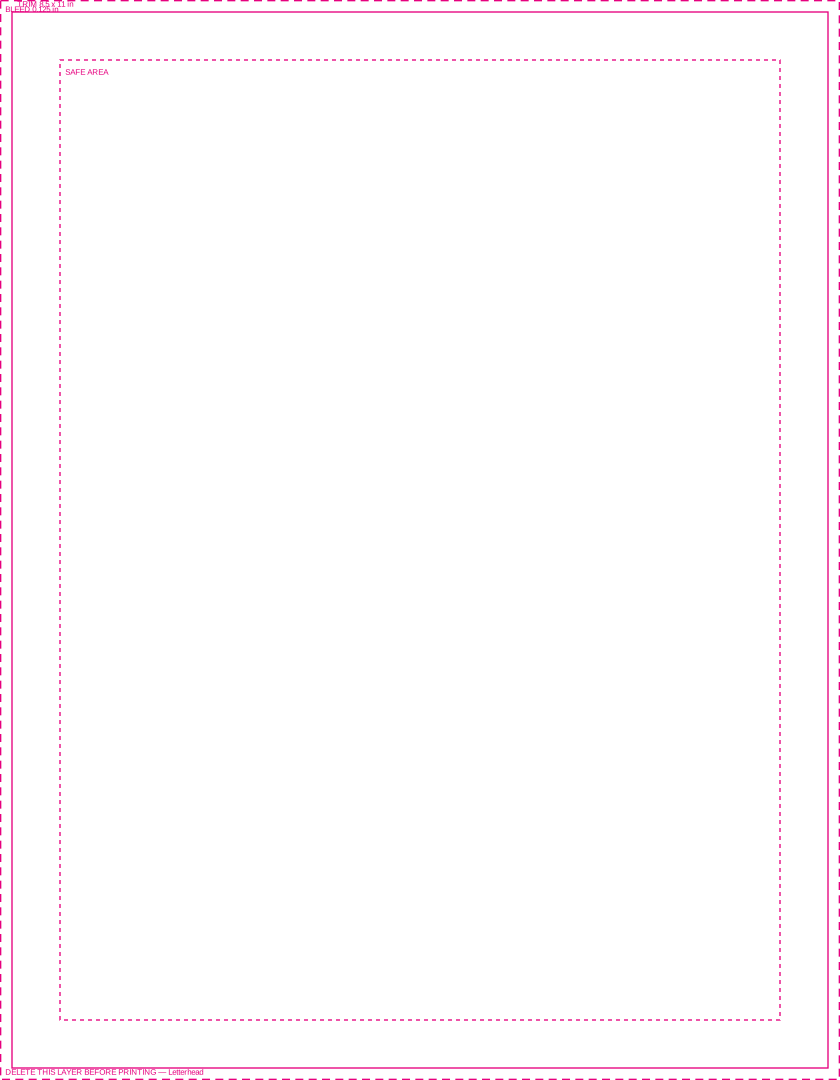
US Letter, 8.5 × 11 inches, with a generous safe area for the typing zone.
The geometry
- Trim size
- 8.5 × 11 in — the finished piece
- Bleed
- 0.125 in on every side, so the document is 8.75 × 11.25 in
- Safe area
- 0.5 in inside the trim, leaving 7.5 × 10 in for text and logos
- Sides
- Single sided
8.5 × 11 in is US Letter. The safe area here is deliberately wider than on other formats because the middle of the sheet has to stay clear for the letter itself.
Download
Letterhead is usually run back through an office printer afterwards, and most desktop printers cannot print to the edge. A design that bleeds off the sheet will work when we print it and then get a white margin when your office printer adds the text. Tell us if the sheet will be reprinted in-house — it changes what the design can do.
If the sheet will go through your own printer, keep the design out of the area your printer cannot reach. That margin varies by printer model, so check yours.
Using the template
What to keep,
what to remove.
The guides are measurements, not decoration. Two of these rules are about not breaking the file, and two are about not printing the guides.
- Do not move the guides
- They are positioned to the exact trim, bleed, and safe dimensions. Moving one makes the file lie about its own size.
- Do not resize the document
- The page is already trim plus bleed. Scaling it scales the trim, and the piece comes back the wrong size.
- Do delete the guide layer before you export
- It is named GUIDES-DELETE-BEFORE-PRINTING in the SVG. Magenta lines are not artwork, and a guide left in prints.
- Do extend backgrounds past the trim
- All the way to the outer bleed edge. A background that stops at the trim line leaves a white sliver after cutting.
What opens it
- Adobe Illustrator
- Opens the SVG with the layers intact. The usual choice.
- Affinity Designer
- Opens the SVG and keeps the guide layer separate.
- Inkscape
- Free, and the layer names are written in its own format.
- CorelDRAW
- Imports the SVG. Check the document units are inches after import.
- Adobe InDesign
- Place the PDF as a guide on its own layer, then build the document to the same trim.
- Canva and similar
- Use the trim and bleed numbers to set up a custom size — these tools generally cannot open a layered SVG.
The SVG is the working file — its guides sit in one layer named
GUIDES-DELETE-BEFORE-PRINTING, so hiding or deleting that one layer
leaves a clean document. The PDF is a reference: its guides are
drawn on the page rather than in a toggleable layer, so if you build in the PDF you
have to remove them yourself.
Exporting and sending
- 01 Delete or hide the guide layer.
- 02 Check backgrounds still reach the bleed edge — removing guides sometimes reveals one that stopped at the trim.
- 03 Convert text to outlines, or send the font files alongside.
- 04 Export as PDF with bleed included. Keep vectors live rather than flattening to an image.
- 05 Name the file so a person can tell what it is — acme-business-card-front.pdf, not final_v3.pdf.
- 06 Send it with your project details so we can check it before anything is produced.
When to ask us instead
- The piece is going in the mail — postal requirements are governed separately and we will send the current specification.
- You want a size that is not on this list.
- The format is die-cut, folded, or finished in any way — the die or the finishing method is the template.
- You only have a logo from a website and nothing else.
- You are matching a colour to something you have printed before.
- You are not sure whether the design will survive the trim. That is a two-minute conversation and a cheap one.
None of these are a problem. They are the moments where two minutes now saves a reprint later — and we would much rather have the conversation before the file is built.
Start here
Will this go through your office printer?
Tell us when you send the file. It changes how the design should be built, and it is easier to handle now than after a box is printed.
- 1 Start your project
- 2 Tell us what you're creating
- 3 Receive your estimate
Prefer to talk? (217) 970-2300 · Mon–Fri, 8am–5pm